Microtransactions and loot boxes: what parents and players should know
Microtransactions are small in-game purchases; loot boxes are a random version. Here is how they work, what the ESRB label means, and how to set limits.
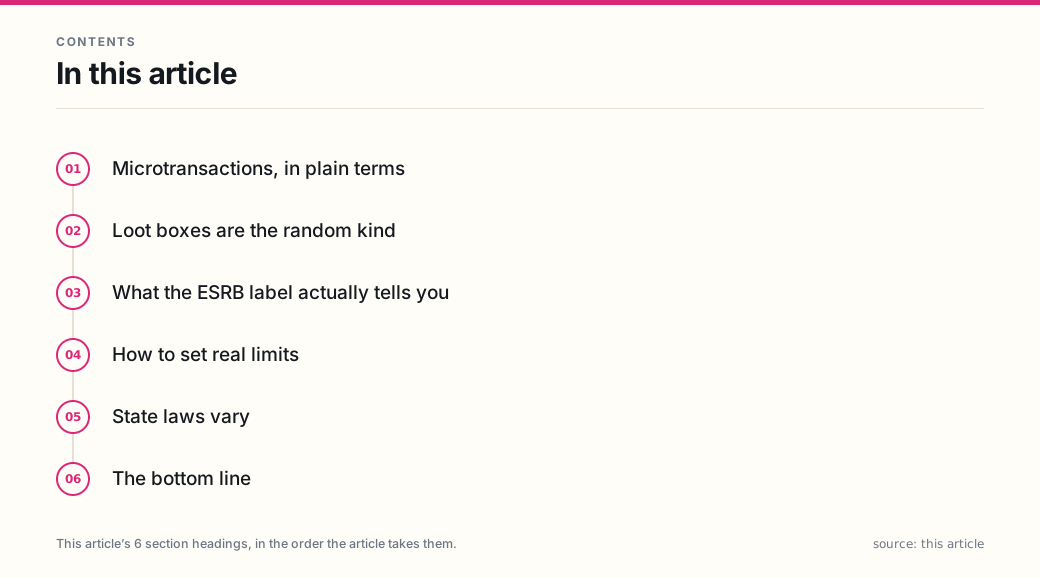
Microtransactions, in plain terms
A microtransaction is any small purchase made inside a game rather than at the register. It can be in-game currency, a costume, a weapon skin, extra lives, or an expansion. The purchases are individually cheap — hence “micro” — but in free-to-play games the design often encourages many of them, and the total can grow large before a player notices.
Loot boxes are the random kind
A loot box (also called a loot crate or gacha pull) is a purchase whose contents are decided by chance. You pay first, then see what you received. Because the result is random rather than a known item, loot boxes sit in a different category from a straightforward buy — both for ratings and, in some states, for regulation.
The U.S. Federal Trade Commission examined loot boxes and other in-game purchases in a report to Congress, and the Entertainment Software Rating Board (ESRB) treats chance-based purchases as a distinct disclosure. Neither treats them as uniformly illegal; the concern is disclosure and the effect on younger players.
What the ESRB label actually tells you
The ESRB now applies two related markings:
- “In-Game Purchases” — the game offers real-money spending of any kind.
- “In-Game Purchases (Includes Random Items)” — the spending includes loot boxes or other chance-based rewards specifically.
The label is a flag that spending exists. It is not a spending cap, and it does not tell you how much a game will cost you in total. That job falls to the controls you set.
How to set real limits
Parental controls are where boundaries actually get enforced. See Parental controls and game ratings: what actually protects a kid for the full setup, but the essentials for spending are:
- Require a password or approval for every purchase on the store account.
- Turn off one-tap or stored-card buying so a child cannot spend without a gate.
- Use the store’s spend-limit or allowance features where offered.
- Talk about the random mechanic — a loot box is not a guaranteed item, and “just one more” is the design.
State laws vary
There is no federal law that bans loot boxes or microtransactions in the United States. A handful of states have enacted their own rules around disclosure or age, and those requirements vary by state. If you need the specifics for where you live, check your state’s consumer-protection agency rather than assuming a single national rule.
The bottom line
Microtransactions are normal; loot boxes add a chance mechanic that makes spending less predictable. The ESRB label tells you spending is there, but the only reliable limit is the parental control or store setting you turn on yourself.
This article is general information about games and spending, not legal advice. Consumer-protection rules for in-game purchases differ by state; consult your state’s official consumer site for current requirements.
Frequently asked questions
- What is a microtransaction?
- A microtransaction is any small purchase made inside a game — currency, cosmetic items, extra lives, or expansions. The name comes from the small per-item price, but the total can add up quickly, especially in free-to-play games that are designed around repeated spending.
- What is a loot box?
- A loot box (or loot crate) is a purchase whose contents are randomly determined. You pay, then find out what you got. Because the outcome is chance-based rather than a fixed item, it is treated differently from a normal purchase in both ratings and, in some places, law.
- What does the ESRB 'In-Game Purchases' label mean?
- It means the game offers purchases with real money, and it now appears on packaging and store pages even when the purchases are only for random items. A separate 'In-Game Purchases (Includes Random Items)' tag flags boxes and other chance-based buys specifically. The label tells you spending exists; it does not cap it.
- Can I get a refund for an accidental or unwanted in-game purchase?
- It depends on the store and the purchase, and the rules vary. Most platforms offer some refund path for accidental buys, especially involving a child, but timing and eligibility differ. Check the store's refund policy and, for kids, use the parental controls below so the purchase is blocked before it happens.
- Are loot boxes illegal?
- Not across the United States. There is no federal ban; instead, a few states have passed laws around disclosure or age limits, and the rules vary by state. Treat any specific claim about legality as state-specific, and check your state's consumer-protection site for current requirements.
Sources
Each source is a primary or official reference, checked before publication. Links open the original.
- Federal Trade Commission — 'Microtransactions and Loot Boxes: Loot Box Workshop and Staff Report to Congress' (the agency's examination of in-game purchase mechanics, disclosure, and effects on younger players; ftc.gov was unreachable in this environment, so the report is cited by name without a link)
- Entertainment Software Rating Board — 'In-Game Purchases' and 'In-Game Purchases (Includes Random Items)' rating descriptors, defined in the ESRB ratings guide (esrb.org was unreachable in this environment, so the descriptors are cited by name without a link)
- Federal Trade Commission — public workshop 'Inside the Game: Unlocking the Consumer Issues Surrounding Loot Boxes' (August 2019), the record of the agency's examination of loot-box mechanics, disclosure, and effects on younger players (ftc.gov was unreachable in this environment, so it is cited by name without a link)